English
We follow a Mastery approach to English through the programme ‘Pathways to Write.’ Units of work are delivered using high quality texts and children in all year groups are given varied opportunities for writing. Skills are built up through repetition within the units, and children apply these skills in the writing activities provided. Many opportunities for widening children’s vocabulary are given through the Pathways to Write approach and this builds on the extensive work we do in school to provide our children with a rich and varied vocabulary.
You will find the end of year expectations for writing, reading and spoken language for each of our year groups in the attached documents. For further detail on the skills that your children are learning on a termly basis, please contact your class teacher.
Curriculum Overview - Whole School
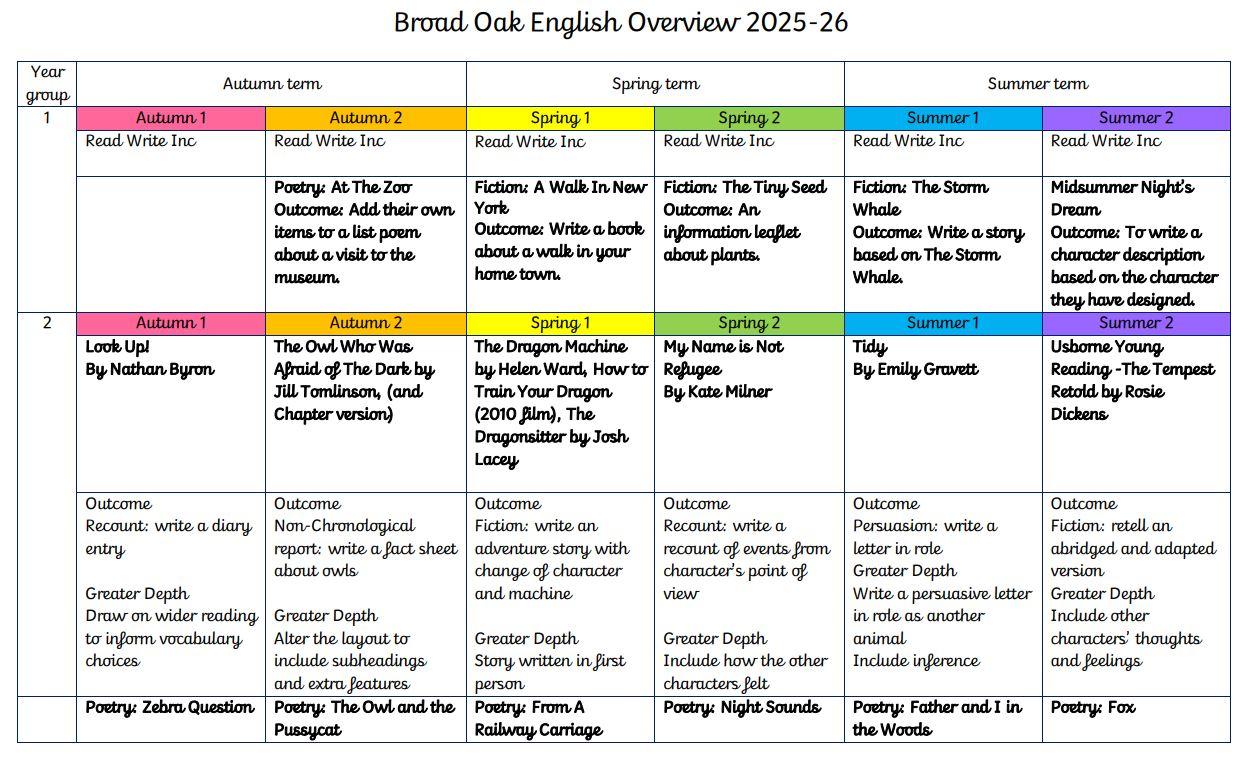
Please see below for our whole school overview to see the texts and poetry units studied in each class, including learning outcomes.
See below for an example overview for Years 1 and 2:
Please see below learning outcomes for each year group:
Intent, Implementation and Impact of our English Curriculum
Intent
At Broad Oak Primary School, we aim to develop a love of reading, writing, and discussion in all pupils. Our English curriculum builds strong literacy skills, extends vocabulary, and fosters creativity, confidence, and enjoyment in both reading and writing. Through access to high-quality texts and structured writing teaching, including the Pathways to Write scheme, we ensure children become capable, articulate, and enthusiastic communicators.
Implementation
Our text-based English curriculum provides purposeful opportunities for reading, writing, and discussion across a range of genres. Reading and writing units are closely linked, and writing is taught using Pathways to Write, ensuring structured progression in composition, grammar, punctuation, and vocabulary. Where possible, English learning is connected to cross-curricular topics, giving children meaningful contexts to apply their literacy skills. Regular opportunities for discussion, editing, and reflection help pupils develop confidence and independence in reading and writing.
Impact
By the end of Key Stage 1, pupils read fluently, write accurately using strategies from Pathways to Write, and can express themselves clearly. They enjoy reading, engage with texts thoughtfully, and begin to apply ideas creatively in their writing.
By the end of Key Stage 2, pupils are independent, confident readers and writers who can analyse, evaluate, and write for different purposes and audiences. They apply grammar, punctuation, and vocabulary skills with confidence, showing creativity, critical thinking, and a genuine enjoyment of reading and writing. Pupils leave Broad Oak prepared for secondary education, equipped with the skills to be lifelong readers and writers.
Please see below for the full Intent, Implementation and Impact Document.
How Reading is Taught
Reading is taught through systematic synthetic phonics. We currently use Read Write Inc in Key Stage 1 and Fresh Start as an intervention programme in Key Stage 2.
The children are taught in groups reflecting the phase of the phonics programme that they are currently working within.
The teaching of reading is supported by a wide range of high quality school and home reading books from publishers such as ‘Oxford University Press’ and ‘Collins’.
Grammar, punctuation and spelling are taught throughout all Key stages.
To find out what each class is doing this term, click on the topic letters under each class heading in the “Children” section.
English Policy 2025-26


